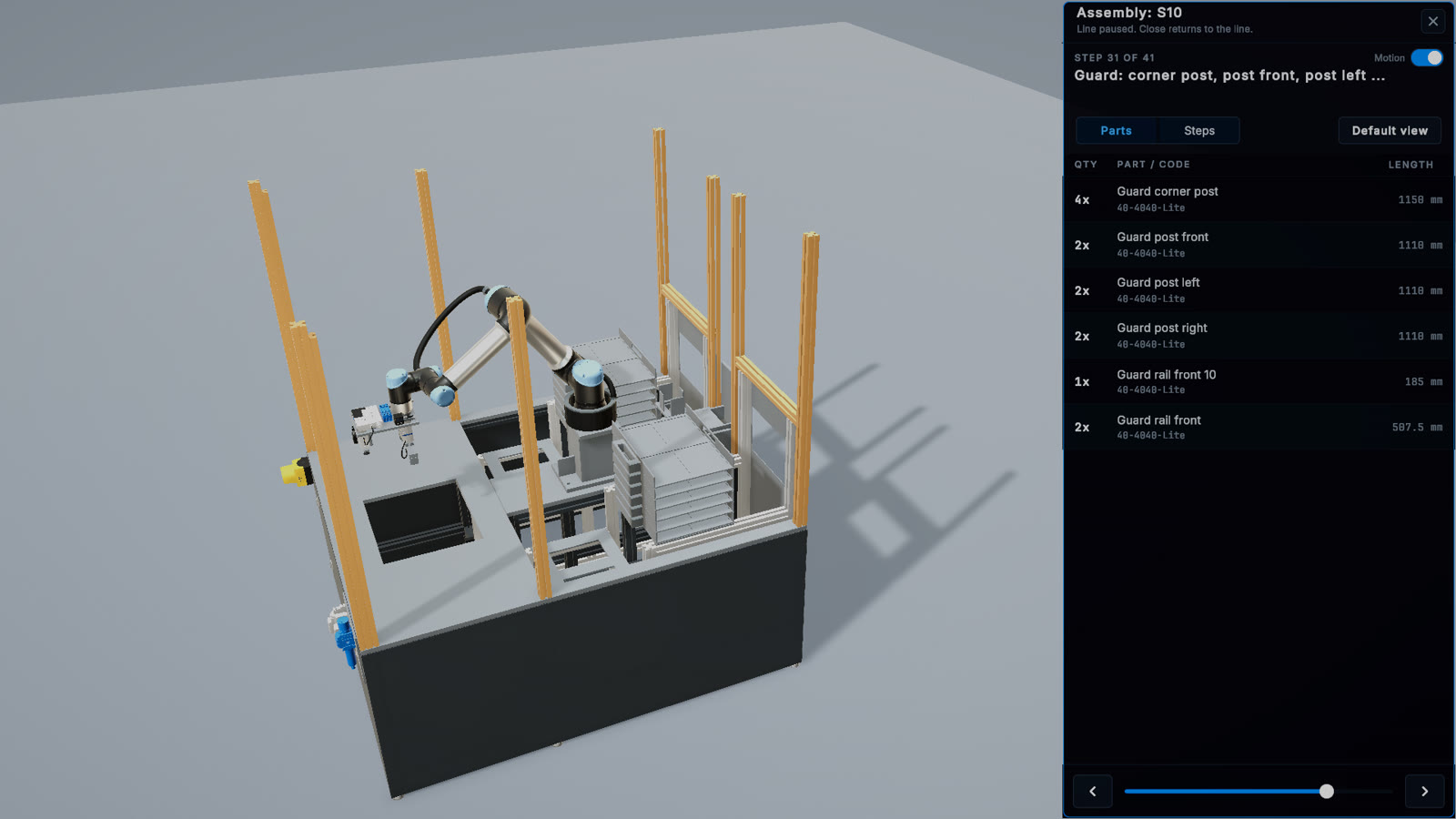
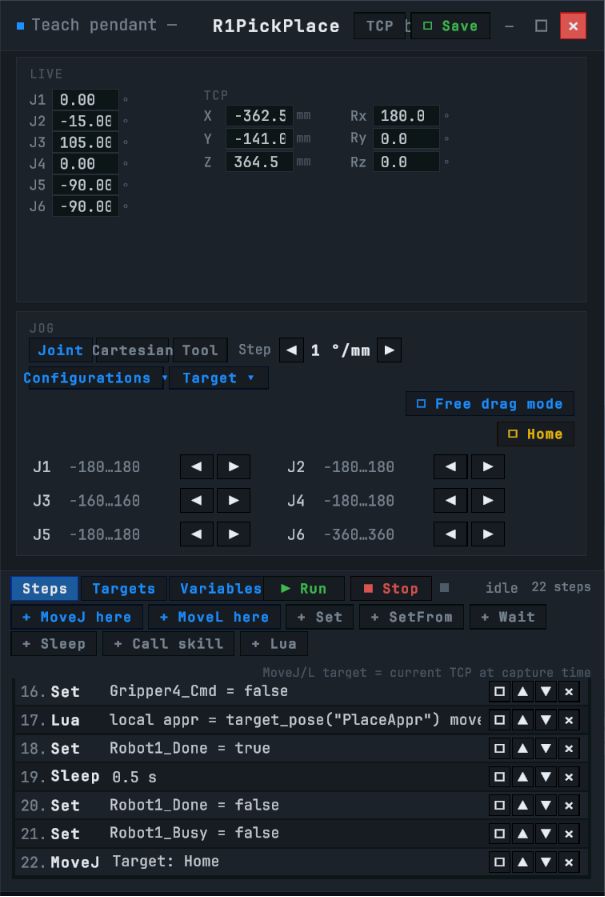
A design ready to implement still has to be built. Some plants and integrators have their own assembly teams. Others need a contractor, and they face the question of how to make sure that the contractor builds what was designed.
What we do and do not do
We do not build or install lines ourselves. Physical assembly belongs to specialists who have the tools, the people and the experience on site.
The customer does not have to find them or coordinate separate contracts, though. They sign a contract with us, and we engage assembly partners suited to the project and supervise that the work matches the design. A customer with their own trusted contractor can use the design, the instructions and the model on their own.
What the assembly partner receives
The contractor does not start from general drawings. The results of stages 2 and 3 are the input to their work:
- CAD of the stations, with drawings;
- a parts list with manufacturer codes, and a cut list;
- assembly instructions, station by station;
- the signal list and programs;
- access to the model, showing how each station should work.
For the partner, this means a finished design in which the logic has been tested and the assembly order is written down. They spend less time on site and can give more attention to the assembly itself.
What supervision covers
Supervision means comparing the work with the design at agreed points, not managing the assembly crew.
| Stage | What is checked |
|---|---|
| Before assembly | Completeness of materials against the parts list and cut list |
| During assembly | Answers to questions from the site, review of deviations from the design |
| After mechanical assembly | Conformity of the stations with the design at agreed reference points |
| During start-up | Sequences and signals compared with the behavior in the model |
| Acceptance | The agreed list of tests, run on the line and compared with the model |
Where a deviation is necessary, because a part is unavailable or the site conditions differ, it is evaluated against the design and entered into the documents, so that the design and the machine do not drift apart.
The model as the reference for acceptance
A common problem in acceptance is the lack of an agreed definition of how the line should behave. Here, the definition already exists. The sequences, cycle times and fault behavior were agreed on the model, so the physical line can be compared with something concrete. Differences are expected: a model does not show tolerances, vibration or the behavior of real materials. These are to be measured and resolved, not argued about.
Responsibilities and contracts
The customer contracts with us, and we engage the assembly partner. Before the work starts, the remaining duties also need a clear division, including:
- who is responsible for the quality of the assembly;
- who takes on the formal role of manufacturer for the line, with the risk assessment, technical documentation and CE marking that go with it;
- who validates the safety functions on the physical equipment.
These matters depend on the project and are set out in the contracts. Supervision against the design does not replace the assembly contractor’s responsibility for the work, nor a compliance assessment.
When this makes sense
This arrangement fits a plant that has decided to invest but has no integrator or assembly team of its own, or an integrator who needs extra assembly capacity. A plant with an established contractor can use the design, the instructions and the model directly.
How to begin
The need for assembly is best raised at the concept stage. It influences the choice of modules, the division of a station into transportable units and the sequence of assembly, and it allows a contractor to comment on the design while changes are still inexpensive.